The thinking behind the tools
Setup Guide
Use the below guide to understand the setup process for quarter midgets. With this knowledge use our Setup Tool to know what changes to actually make.
This is setup knowledge that has been shared with us, that we have learned, that we have applied — but it is not complete. We learn every race. We hope it helps you!
Start here
Three things that make the rest make sense.
Timing vs amount
Shocks change when. Springs and bars change how much.
Shocks control how fast weight is transferred. Springs and panhard bars control how much. So a shock change is a timing change — it moves the balance earlier or later in the corner. A spring or bar change moves the balance itself.
Push → loose
A tight car can look loose on exit.
A car that's too tight can demonstrate a loose exit, because the driver has too much steering input. The tire eventually gains grip and then snaps. We call that snap oversteer, or push → loose. A loose car will always be loose. A tight car might not be.
Which end to fix
On asphalt, fix the weak end. On concrete, free the strong end.
Most asphalt doesn't have grip to spare, so add grip where it's missing. Most concrete has plenty — so taking grip away from the end that's already working can be the faster call.
One warning
The exit is the hardest corner to tune.
Adding grip to fix an exit problem will usually create an entry problem. Exit tuning is mostly a driver tune, or a small shock or cross weight adjustment. Focus on getting the car right from entry to apex. If the balance is right through the center and the driver isn't turning in early, the exit will usually take care of itself.
Tilt and tires
The one adjustment that does two jobs.
Tilt is ride height side to side — right against left. It isn't rake: rake is front to back, and quarter midgets don't run rake. Tilt acts mostly at the center of the corner, much like stagger, but what it really controls is how the tires come in.
Traditional tilt — right side slightly higher — loosens the car and preserves the tires. They come in slower but last the run.
Reverse tilt, also called negative — left side higher — tightens the car and fires the tires off fast. They can then overheat and lose grip on a long green run.
Tilt is the only change that moves the balance and the tire come-in at the same time. That's why it's worth knowing which way to go before you touch anything else.
- AmountUsually no more than 1/8″ to 1/4″ either way. 1/8″ is a real fine adjustment.
- Ride height1½″ without driver is traditional. Never below 1⅛″ on either side.
- OrderTire pressures first, then ride height and cross weight together — ride height changes cross weight.
- WhereFrame rails, all four corners. Exact spot is chassis-dependent.
- DriverMost cars aren't measured with the driver in. Some are, and their chassis sheet will say so.
- CarefulDon't change tilt and stagger in the same session. They act on the same part of the corner and you won't know which one did the work.
Reverse tilt
Left higher. Tightens the car and fires the tires. Both problems fixed by one change.
More rear grip
Tilt can't help both — reverse tilt fires the tires but tightens a car that's already loose. Lower the rear panhard bar on frame instead.
Front grip only
Reverse tilt would fire the tires but make the push worse. Add front grip — lower the front panhard bar on frame, or reduce RF spring rate.
Traditional tilt
Right higher. Loosens the car and preserves the tires. Both problems fixed by one change.
Coming in too late
Not good until ten laps in
Lower the right side or raise the left — reverse tilt. It makes the tires fire off fast, but they can then overheat and lose grip on a long run, so use it knowing what happens later in the race.
You can also add grip at both ends together by changing the front and rear panhard bars equally: lower the frame side on both, or raise the axle side on both, so the balance doesn't move.
Falling away
Fast for ten laps, then it goes off
Raise the right side or lower the left — traditional tilt. It preserves the tires instead of punishing them, so they're still there at the end of the run.
Finding the right balance between reverse, flat and traditional tilt is the whole game. Control tire heat with tilt and the car stays fast for the whole run.
Heats are short and features are longer, and only green-flag laps count. A tire problem that never shows in a heat will show up in a feature.
Stagger
Stagger isn't balance. It's radius.
Stagger doesn't really change how the car is balanced — it changes how tight a circle the car wants to run. Think of it as altering the radius, not the balance.
More stagger makes the car want a smaller circle. Less stagger and it wants a bigger one. That's the whole effect, and it's why stagger can feel like a balance change without being one.
The catch is the straight. More stagger means the car is naturally trying to turn left the whole way down it, so you're fighting it — that's scrub, and scrub is speed you don't get back. So every stagger decision is a trade: corner radius against straight-line speed.
That trade is also why it gets confused for balance. Too little stagger and the car won't rotate into the corner, so it feels like it's pushing. Too much and it feels loose. Both are real feelings, but the cause is radius, not grip.
- Low end2½″ of stagger
- Normal3″ is a typical starting point
- High end3¾″
- More staggerSmaller radius, more scrub down the straight
- Less staggerBigger radius, less scrub, but the car won't rotate
- Feels likePush at the low end, loose at the high end — without either being a true balance problem
The trade
A tight corner costs you the straight.
If the track has one long straight and one tight corner, you can't have both. Pick the one that costs you less lap time — and remember that more stagger always means more scrub, so the car that turns best may be the car that's slowest at the end of the straight.
Gearing
Chasing the right RPM.
There's a perfect gear for a fast lap, and often a better one for restarts. The calculator is on the tools page.
How much is one tooth?
- AxleOne tooth is worth roughly 175–200 RPM.
- EngineOne tooth is worth roughly 100–125 RPM.
- BothOne tooth on each, the same direction, is worth 50–75 RPM.
- Which endChange the axle for a bigger step, both for a fine one. The axle is easier to get to, and the gears cost the same either way.
Belt drive needs higher tooth counts than chain drive, so each tooth is a smaller share of the ratio. Work from the numbers above and confirm with the tach; the fine detail is in the final drive ratio, which is a job for someone who already knows their car.
Things worth knowing
Ask your engine builder for the target. It changes with the class, the engine, and who built it. Nobody else can give you that number.
Gearing goes stale. As the driver and the setup improve, lap times drop and RPM rises at the same gearing. A ratio that was right a month ago may not be right today.
The gear charts have errors. There are at least two charts in circulation for chain drive, plus others for belt drive, and some contain formula mistakes. Every Honda has the same gear reduction and every Briggs has the same reduction, so a chart showing a different final drive has a maths error — not a different reduction. When in doubt, compare your gearing with somebody else's.
Rookies need restart gears. The perfect fast-lap ratio can leave you struggling on restarts and in traffic. If you're one of the quicker cars, one or two teeth the other way costs a little on the fast lap and pays you back every time the yellow comes out.
Where this came from
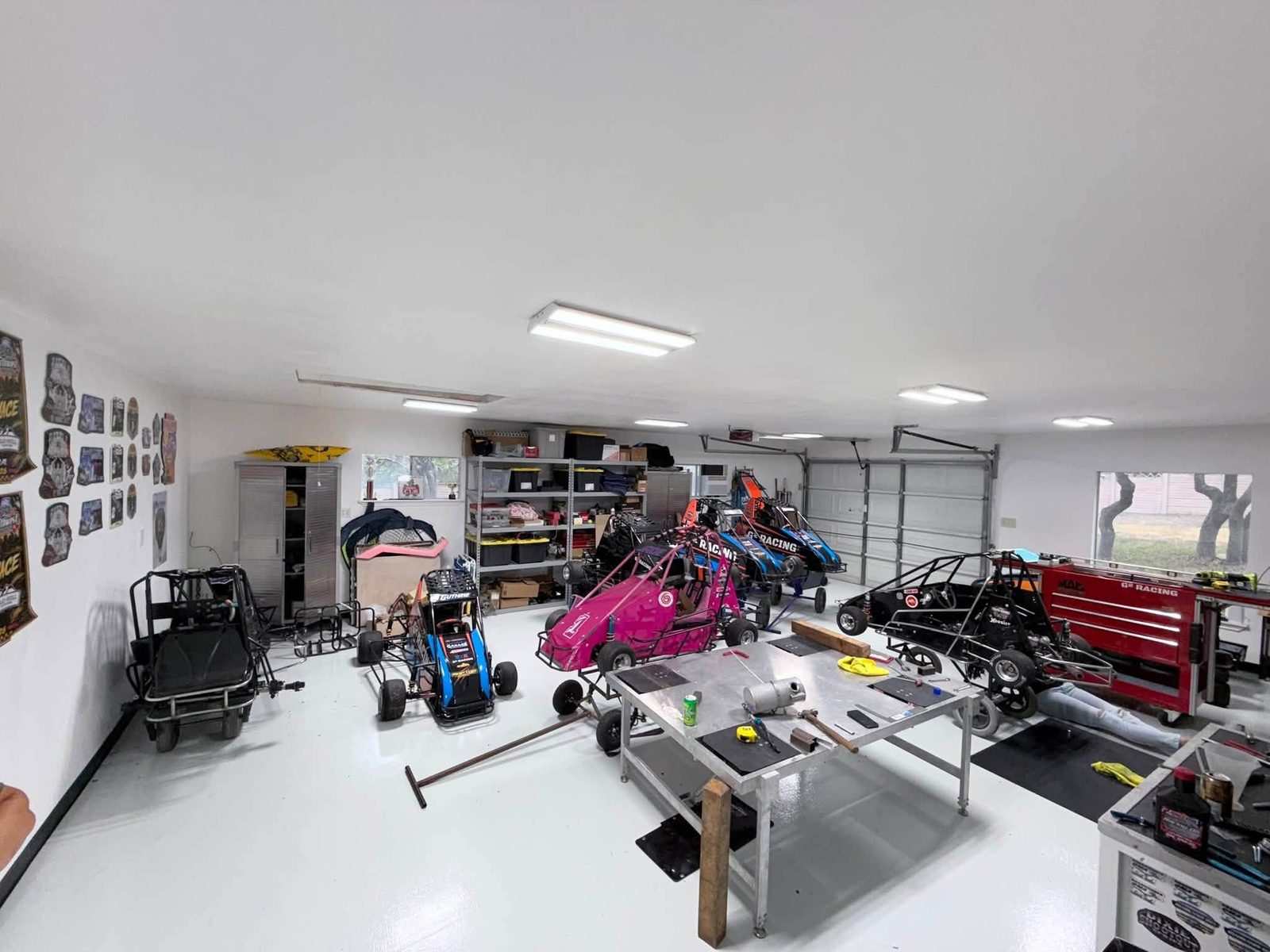
Compiled by G² Racing over many seasons — our own notes, our own mistakes, and the experience of other racers.
With thanks to Brian at Second Shift Motorsports and Advanced Racing Suspensions.
A general starting point, not a set of rules. Check for bottoming before changing ride height. Follow your chassis builder's guidance and your track's rules first.
v1.1 · October 2026